
Even if all these facts about AI were *not* true, it would still be destroying us.
Why I refuse to use ChatGPT, and how I believe it's making us stupider.


I am aware that this piece will probably offend some people. But I am not willing to dally around. I am thinking about offense, and candidness, and truthfulness, as I type it all out myself; I refuse to couch these opinions in someone else’s words. Everything you are reading here was written by me. Everything you will ever read on this website was written by me, unless it is specifically quoted and attributed to another human author.
I feel very strongly about (AGAINST) the use of generative AI, and I realized recently that I hadn't ever laid out in plain English why I am opposed to it. There are a lot of very important smaller reasons, and one big one.
(Before I begin it's important to me that you understand that when I say “genAI,” I am talking about programs and apps such as ChatGPT, Claude, OpenAI, Midjourney, Grok, and whatever nonsense the Best Buy customer service website is using now instead of a human representative. I am not talking about the use of artificial intelligence in the computer and medical sciences, about which I do not know enough to speak definitively. I am talking about the use of AI in the humanities and for personal daily enterainment: to create images and videos, to write social media posts, to “create” in a manner that is meant to mimic a human. Do not come for me in the replies with some “oH sO yOu dOn’T tHiNk onCOloGIstS sHoUlD uSE rAdiOLoGy pRoGrAmS thAt cAn sPoT cAnCeR” comment.)
The Environment
Put simply, genAI is burning up our usable drinking water. And it’s doing so in a way that does not render the water recyclable or reusable in any other capacity— it is literally eradicating fresh water. Your electric bill will be higher soon, if it’s not already, and the emissions caused by massive AI data centers are producing thousands of tons of carbon dioxide, which as I’m sure you know is not great for our climate.
“Of all of the concerns with AI, one of the most commonly cited is its impact on the environment. In fact, Americans are more likely to name AI as an environmental concern than other prominent environmentally harmful activities, including meat production, air travel, and cryptocurrency mining. One aspect that’s gotten a lot of attention in particular is the rapid growth of data centers, which are warehouses of computers used to train AI models. These centers are cropping up all over the country and the world, consuming massive amounts of energy, increasing local electricity rates, and even creeping into land set aside for our national parks.”
—Andrea Jones-Rody in What AI Costs the Environment
“But lots of other things use water! Look at farming! Farming uses TONS of water, way more than AI!” people will say. Yes, and you know what farming gives us? Food. Textiles. Things we NEED, not a picture of Marco Rubio dressed as a combo Ayatollah/President of Venezuela. The ROI on AI images is not remotely comparable to the growth of soybeans. Get a grip.
Theft from Artists
Every image that’s created by genAI comes from a massive amount of digital artwork that was fed into a water-guzzling data center by a “data trainer” who definitely did not have permission from the artists in question to use their creative work as a model. A computer cannot have an original thought. A computer cannot truly generate an image; it can only predict a sequence based on thousands of millions of previous sequences that have been (illegally) shown to it. Artists have the legal right to the reproduction of their work, and no matter how many of Sam Altman’s minions try to put the “tech bro” into “technically,” (is this anything? hmmm no) it is unethical to take someone’s creative work without their consent and feed it into a Plagiarism Machine so that the Plagiarism Machine can copy it so you can have a “Studio Ghibli style” profile picture on Facebook. No one should need to have that spelled out for them, and yet.
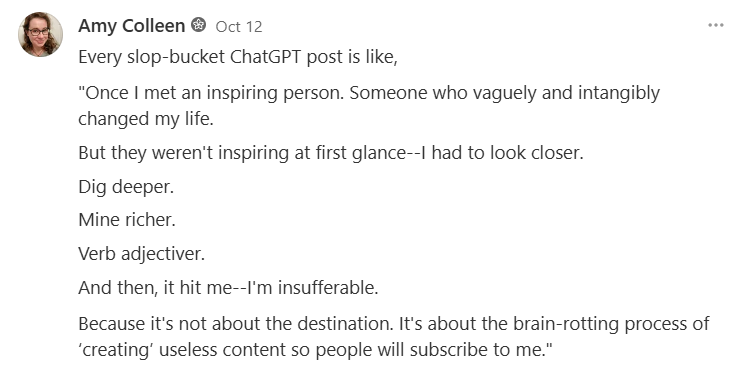
This goes for both visual art and written work, by the way. The Atlantic published an exposé in 2023 about the thousands of ebooks which had been pirated and used to train Meta’s AI software. Anything you write on the internet, technically, can be scraped by a bot and fed into a Language Learning Model (LLM) so that your style can be mimicked. It’s not cute, it’s terrifying. (And yes, the “it’s not X, it’s Y” format in clickbait social media posts is beginning to drive me mad. Once you see it, you can’t unsee it.)
There’s a false and pervasive idea that if you put something on the internet, it becomes free for anyone to use for whatever purpose. There’s also a false and pervasive idea that the moon landing was faked and that the 2020 election was stolen. The fact that people believe these things doesn’t make them true.
Deepfake Porn
Listen, I don’t want to talk about this any more than you want to read about it, but let’s just say, if someone with nefarious intent uploads a photo of you to Grok, Elon Musk’s gross AI feature on X, they can create an image of you in a nude and highly compromising position in seconds. It does not matter if you didn’t give consent. It does not matter if you’re not an adult.
This is one of many reasons why I don’t share identifiable photos of my children on the internet. I’d urge you to consider locking down your digital circles, too.
Deception
When you “write” something with the help of AI, even if it didn’t draw anything from a proprietary source, it’s still not your writing. And if you pass it off as your own, that may be legally legitimate but the ethics are dubious at best.
“Oh, I never claimed I wrote this,” people will say, smugly, as their LinkedIn and Threads accounts churn out an endless scroll of bland, mindless drabble. Yeah, okay. Maybe not in so many words. But you hit “post” with your name attached and no citations. High school students know what that means. Pull yourself together.
Mistakes Galore
As long as you have a webpage with enough traffic to appear high in Google search ranking, you can say anything you want and it might get included in the “AI search results” Google roundup. People have tested this theory with silly stuff like a recipe for adding glue to pizza cheese, but it’s far from funny.
Suicide encouragement, bald-faced lies about easily-verifiable facts, and the germinating of psychosis from chatbot significant others (I wish I were making this up) round out the list. I could go on and on and on. I won’t.
It Looks Stupid
Your soulless, shiny, cookie-cutter graphics are ugly. Use the free version of Canva and a single ounce of chutzpah. I believe in you.
All of these facts, taken separately, are bad. Quite frankly, each one of them alone ought to be enough to discourage you from using genAI. And yet even if all of these things were not true— if someone invented a version of genAI that was completely ethically trained, never violated anyone’s privacy, was completely carbon neutral and looked flawless— I would still be against it. I would still urge you not to use it.
Because it is atrophying your brain into a colander of limp spaghetti.
Your imagination is a muscle that must be exercised. If you, like me, have trouble returning to your childhood fancies with the same abandon, it’s likely because you, like me, haven’t done it very much in the last decade or two. If you stop thinking about magical lands, it becomes much harder to return to them. And if you stop drawing pictures and writing words and coming up with your own thoughts, is it any wonder if your whole theory of being becomes more difficult to articulate?
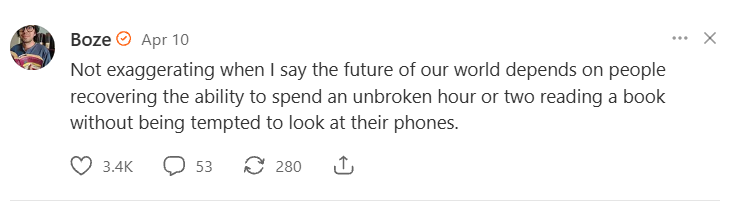
You cannot just scroll, you cannot just watch, you cannot just ask Chat to summarize the text for you. “We’ve built machines that promise to relieve the burden of painting, writing fan-fiction and even playing video games so that we have more time to look at our phones,” says Boze Herrington. Ewww??? EWWW. What are we doing????
Creating art is not a burden. You do not have to make art! You truly do not. I mean, yes, on a certain level we must all tell ourselves stories in order to live (thanks Joan Didion) and even if you live without an inner monologue I do not think you can thrive without at least an inner narrative, but you do not have to make pictures or stories for other people to consume, and if you choose to do so, you have the responsibility to make something good and true and beautiful. I can’t find the exact quote now, but recently Karen Swallow Prior wrote something about the abundance of AI-generated slop infesting the book industry— and how it doesn’t have to be this way! You are not required to be a writer. If you can’t write, and you can’t even conceive of putting words together without the help of a program, then don’t.
And what of the non-creative writing, the stuff no one could call artistic yet we all need to do every day? The emails, the product listings, the notes to our families and friends? Shunting that off to genAI is not only lazy and disrespectful to the people with whom we are communicating, but it’s strangling your ability to do this work yourself.
“ChatGPT is making you boring,” argues Hayley DeRoche (who also wrote the brilliant Things You Can Ask ChatGPT to Write For You). I would add that it is also making you dumb. You do not need GoogleAI to summarize an email for you. You do not need ChatGPT to tell you to call the doctor for a weird rash that won’t go away. You do not need a chatbot to write a book report or fill out a personality test or answer the damn essay questions for an ENGLISH LITERATURE CLASS where you are supposed to be STRETCHING your damn BRAIN! (yes! This is a real-world example! I sit behind you, [Redacted]! I can see your screen!)
Sorry for swearing, I have a lot of feelings, unlike a COMPUTER.
AI is not capable of saying “I don’t know.” Did you know that? If you ask a chatbot something and it can’t answer the question, it will make something up, and if you call it out it will make up something else, and maybe it will reformat its search function but it will not say “I don’t know.” Because if you can’t ever truly know anything, you can’t know what you don’t know, you know?
There’s a lot of discourse out there right now about the future of writing and books, and I want to reassure you that when it comes to poetry, we’re all good. AI literally can’t write a poem. Anyone is welcome to try. It’s not real. It's just dead words. A computer system can’t feel lust, endure jealousy, taste her grandmother’s chocolate cake, watch a child be born, trip walking across a stage in front of 500 people, have a first kiss, or hold their loved ones hands while they cross to the other side. Poetry is made strictly of human experience. There’s no wiggle room. What a gift.”
—Kate Baer in Dear Reader
“Very few writers know what they’re doing until they’ve done it,” Anne Lamott writes in her famous essay on shitty first drafts. (That one was Anne, not me. I, like Emily Starr, am “only kwoting.”) You cannot write anything good without human experience—both the experience of living, and the experience of actually writing.
I did a rough estimate of how many words I’ve written in the course of a lifetime. When you take together days of relaxation and not writing anything, mixed with spiral notebooks in childhood and NaNoWriMo as a teen and the hundreds of thousands of emails I’ve sent to friends and for work, the dozens upon dozens of blog posts and Twitter threads and and and and and—
—if you assume something like 200 words a day for 26 years (since I learned to write) it’s nearly two million. Probably more. I don’t know. I’m not a computing machine.
Every time I write anything, I think about how much farther I have to go, but I’m also, sometimes, delighted and awed by how far I’ve come. That isn’t vanity, it’s just frankness. The way I used to write as a dramatic seven-year-old would-be novelist is very very different from the way I write now, as it should be, and it happened because I have a functioning brain that matured and was worked, hard, and now it can do things it couldn’t do even two or three years ago.
“My fingers,” says Elizabeth Bennet to Mr. Darcy, “do not move over this [piano] in the masterly manner which I see so many women’s do. They have not the same force or rapidity, and do not produce the same expression. But then I have always supposed it to be my own fault— because I would not take the trouble of practising.”
Darcy smiles then (take that, Colin Firth!) and says, “You are perfectly right. You have employed your time much better. No one admitted to the privilege of hearing you, can think any thing wanting.”
And you know what? He’s wrong! He’s blinded by love! That’s the whole point. Elizabeth is not a good pianist, because she doesn’t practice. But Darcy doesn’t care, because he’s smitten. And if this little analogy were translated to modern day, of course, it would not hold up, because there is no way in the world that Elizabeth would ask ChatGPT to play the piano for her. None of Austen’s heroines would, except maybe Catherine Morland, and she would learn from her mistakes, as she is meant to do.
Are we, the stubborn Luddites who refuse to ask ChatGPT, being “left behind” by tech?
If we are, I’m fine right here. I’m happy with my books and the brain I have to read them. I’m happy with my refusal to get with the times. “I think we will look back with regret if we don’t act now to temper AI, if we don’t change our posture toward AI to one of prudent skepticism,” writes O. Alan Noble.
“I don’t think the problem is that writers don’t accept that AI is here to stay.
That argument is a straw man.
I think the problem is that people using AI don’t understand that to some people, the craft of writing is what matters. The slow and painstaking development of skill.
I am one of those people.
And I don’t want to see the art and craft of writing become the sacrificial lamb on the altar of productivity or profit. So I do the only thing I can. I write about it.”
(Linda has written a lot about AI. It’s worth reading.)
I am going to keep writing and I am going to keep refusing to plug prompts into a BOT, for any purpose, and I hope you will too.
And I will drink some water while I do it, while it lasts.
As a highschooler who used AI because i was deeply insecure of my writing and deathly afraid of seeing red ink on my paper, this was really eye opening. The upcoming essay will be one of my own words and ideas, even if it costs me a fraction of my confidence. Thanks!
I really appreciate this manifesto, Amy!