
On audiobooks, and the Boxcar Children philosophy of work
Listening while driving and thinking about building character.

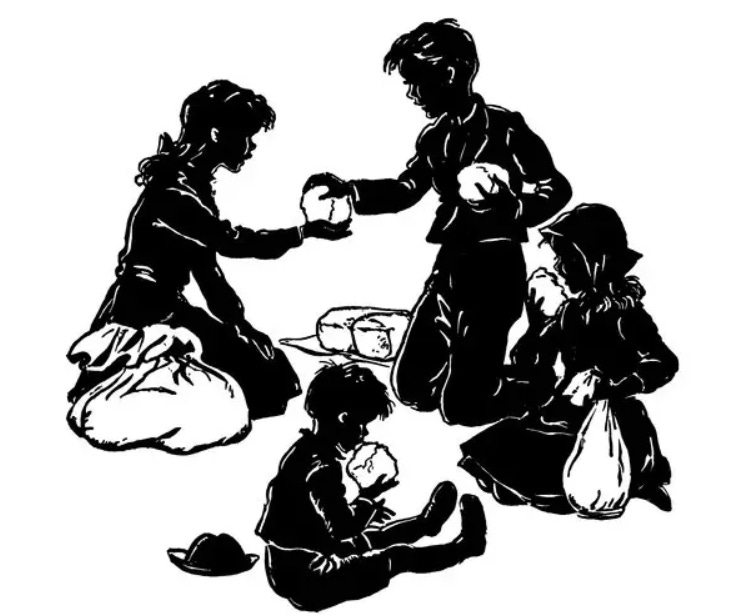
My kids are almost finished with our library’s summer reading program, and it is not yet July. I say this as a little bit of a flex. I am not ashamed of it. I’m proud that we prioritize reading, that I read aloud to them every day, that the >100 picture books scattered around our house, in bookcases and under sofas, do not gather dust. Well, maybe the ones under the sofa do. But my three-year-old is quite industrious about demanding that adults lift the sofa on a regular basis so he can go spelunking, so they get pulled out pretty frequently too.
Because we read so much, and because I am always worried about being accused of fraud somehow (despite a scrupulosity from childhood that recoils from ever falsifying information on a form, no matter how insignificant) I feel awkward about filling out the reading log too quickly. So in order to make the log last until the August 1st prize retrieval day, I’ve decided to record mostly chapter books instead of the dozen picture books we haul home from the library every week. And those titles have, overwhelmingly, consisted of Boxcar Children titles this month.
I can’t remember when, exactly, we began listening to audiobooks in the car together. It must have been at least a year or so ago; a time when I was fed up with constantly switching from song to song on the Bluey album and instead put on a Ramona Quimby novel narrated by Stockard Channing. Though my younger son wasn’t (and remains not) very impressed, preferring music or the asinine Handyman Hal podcast, my five-year-old was quickly captivated by what I and my fellow millennials still stubbornly refer to as books on tape. It’s hard, with a five-year-old, to thread the needle between attention-grabbing (and long enough for a full car ride) and too scary or incomprehensible. The Boxcar Children has, thus far, fitted the bill.
If you aren’t familiar with the series, and somehow didn’t grow up with the ubiquitous Scholastic paperbacks, this piece might not mean much for you. But if you did read the Boxcar books as a kid, then maybe you will understand what I mean when I say that the original 19 books1 are… so much deeper than I remembered??
I grew up reading the Boxcar Children along with the Bobbsey Twins and Happy Hollisters, and I sort of lumped them all together in my mind. Family of children who never fight and solve benign mysteries in their copious spare time. It’s a genre of its own. But, perhaps because Gertrude Chandler Warner actually wrote all of her own novels,2 the Aldens—tidy and perfect though they always are—seem to reach down a little deeper into the human condition than their contemporaries.
Take Mystery Ranch, for example. The main conceit of the story is that the Aldens go to stay on their great-aunt’s ranch to care for her while she is sick. They befriend their crotchety Aunt Jane, take care of a stray dog, and discover uranium on the ranch which was good news because this book was written in the 1950s and the Alden children were canonically not old enough to really remember Hiroshima and hadn’t lived through Chernobyl yet.
I digress.
Like many other children’s books of the early-to-mid-twentieth-century, Mystery Ranch revolves around the thawing out of a cold and taciturn elderly relative. Aunt Jane and Grandfather Alden quarreled when they were young, over family property (not, as you might assume, over the fact that their parents shortsightedly named them James and Jane) but the Alden grandchildren bring her back into the family fold with patience, devotion, and generosity. It’s a heartwarming, if predictable, plotline. The Aldens care deeply about family connections, and the theme of reuniting estranged relatives occurs in several other original Boxcar Children books. (It is odd, though, that the deaths of their own parents are never mentioned, as far as I can remember, beyond the first book.)
The running thread of all the stories, though, is the Alden children’s hard work, and I realized this while only half-listening as we waited at stop lights and my three-year-old shrieked for me to put on The Search for the Tool Fish Adventure instead. They rebuild houses destroyed by fire, pitch in to do garden work, fix up a lighthouse, teach school. The trips that form the framework of each story are always sponsored by their wealthy grandfather, of course, but with the exception of perhaps Blue Bay Mystery, the destinations are never luxurious, and wherever the Aldens end up, they put their shoulder to a task, literally.
The thing is, they don’t have to. Grandfather James Alden’s wealth is a bit of an enigma—he’s a steel mill magnate in the earliest books, and the owner of a “fine plastics factory” in later Warner novels, but whatever the source, his credit and charge accounts seem to be as unlimited as those of Carson Drew, the well-known lawyer.3 One would expect the Alden children, heirs to millions, to live a life of privilege and leisure, enjoying the finest experiences that their patriarch has to offer and associating only with the most well-bred and hoity-toity families. Instead, we find them packing their own sandwiches rather than ordering room service, setting off on a bicycle trip instead of cruising to Europe, and taking as much interest in hosting ten-year-old Rory for an extended school vacation (Mystery Behind the Wall) as they do in traveling down the river on a houseboat.
In Mike’s Mystery, Mr. McCarthy, the night watchman at the uranium mine, says to Jessie,
“I can’t understand why you children want to work at all. Don’t you own the mine? Your grandfather ought not to let you work.”
Jessie shook her head. She said, “That’s not the way Grandfather thinks. He has lots of money already. But he says everyone ought to work. Nobody can be happy unless he has some work to do. …When we get through school, Grandfather wants us all to go to work for a living.”4
Trust funds and executive positions don’t even enter the equation. The Aldens seem to regard their wealth as a mildly interesting but ultimately irrelevant exotic pet; a gold-plated hermit crab that doesn’t leave its cage and therefore isn’t a major player in anyone’s life. Their money supports their lifestyle, of course, but in an unassuming way that elevates genuine experience over the best things money can buy.
In a world of Bezoses and Musks, trillionaires and venture capital, this perhaps-outdated mindset is heartwarming to the point of unbelievability.
Who, today, would live like the Aldens?
I don't make a habit of writing in depth about my children's private lives. I write about parenting at the parenting newsletter I edit, The Pomegranate, but I try to straddle the line between writing about my own experience as a mother and delving too deep into my children's experience.
So I am going to be a little bit purposefully vague here when I say one of my kids is having a very tough time right now. We recently (finally) got a mental health diagnosis that confirms my neurodivergence suspicions, and we’re figuring out how to best support that child, and our whole family, through a difficult season. Everything I thought I knew about the cause and effect of consistent parenting, and discipline, and instruction and teaching and instilling good principles is really hard to square with the DSM-5.
There is so much I don’t know. There is so much I am going to screw up. As I write this, I am actively trying to calm my own nervous system, to settle myself after a particularly dysregulating day.
We are listening to The Deserted Library Mystery right now; on the way to therapy, and on the way home from the library, and to and from the grocery store and to Grandma’s house and back again. I wonder, sometimes, how much my kids are absorbing. As we listen to stories I read and reread in my own childhood, fragments of narrative I thought I’d forgotten are coming back to me, etched as they were into a corner drawer of my brain by fond repetition. Ali thanks you. We all thank you.5
It isn’t all gems of happy childhood memory, of course. I would be remiss if I didn’t point out that the Boxcar Children books are admittedly A Product Of Their Time, most notably with the depiction of Native Americans in Surprise Island and The Yellow House Mystery, both of which are not hateful but definitely maintain stereotypical and patronizing portrayals of indigenous people. At certain points, I’ve felt compelled to pause the story and take a moment to explain why we don’t use the word “Indian” anymore. My kids are impatient to get back to listening, nodding and mm-hmming with what seems like complete fecklessness. They are white boys, living in the U.S. with two involved parents and the prospect of a solid education; no plastics factory nor steel mill dividends for them, but nevertheless they sit in their safely buckled car seats ensconced in privilege. What am I going to teach them about their role in a world that is primed to hand them opportunity, that wants to urge them to work hard so they can amass money and power?
I used to think it was as simple as setting rules and enforcing consequences; having a family code of ethics, and explaining the straightforward ways in which we would encourage good behavior and discourage the bad. I would lead by example, naturally. I’d be patient and gentle and understanding, and my children, secure in their attachment to me and cocooned in the predictable expectations of our family life, would only need the most natural and organic instruction to set them on the path for Model Citizenship. We’d be raising good neighbors, just like Mr. Rogers. No one would hit or hurt or scream (or if they did, it would only be once, before they Learned Not To) or display worrying anxious behaviors. The problems I have kept wrapped up tight in my own brain would never manifest in my sweet, innocent children—perish the thought! I would do this right.
I’m not sure when the illusion vanished. Maybe at the first vestiges of colic? Who can say. I was so sleep-deprived.
Gertrude Chandler Warner’s path to literary stardom was not an easy one. Her first iteration of The Boxcar Children in 1924 was far darker than the later edition which readers today know and love, and it wasn’t well-received even by her own elementary school students. (The parents’ deaths are far more present thematically in the original.) Warner’s own life was marked by frequent illness and injury, trauma from two world wars making a lasting imprint on her career (she became a schoolteacher as a temporary job which became permanent when her colleague succumbed to the flu pandemic). The Alden children’s lives, sanitized though they were by careful editors, still managed to reveal a great deal about her values and what she held dear.
Family. Integrity. Hard work. Giving of what you have to those in need, and using what you’ve been blessed with—financially, intellectually, spiritually—to improve the lives of those around you.
I would love to write up a manifesto of what I want my children to learn, and how I want them to go about it. I wish I could rewrite all the mistakes I’ve made, wipe the slate clean and say “here is your formula for life, if you will only follow it to the letter. Also, don’t develop anxiety.” I can’t do that, but I can guide them toward books that highlight the good, the true, and the beautiful. (And I can choose audiobook versions when the weird 1960s paperback illustrations do not reflect those virtues, lol.)
The Aldens’ choices to spend their leisure time don’t, on the surface, seem to make a lot of sense. Why should they do menial work when they don’t really stand to gain anything from it? What could they possibly enjoy about the repetitive labor of raking leaves and scrubbing floorboards and cooking food over a camp stove, when they don’t have to do any of that?
But none of that work is done in solitude. Wherever Henry and Jessie and Benny and Violet go, they make friends. The work they do isn’t pointless because it’s always in service of someone else. “Nobody can be happy unless he has some work to do,” Jessie told Mr. McCarthy. The work she is talking about, in that moment, is that of helping Mike’s mother to start up her pie business, after losing her house and everything she owned in a fire. The Aldens didn’t have any obligation to Mike’s family, but they set to and helped out anyhow.
I can’t tell my children, “This is who I want you to become.” I mean, I could, but it wouldn’t go anywhere. They would ask what was for lunch, and complain that I had paused the audiobook.
But books are what form us, aren’t they? Wasn’t Jesus Himself the Word made flesh, to dwell amongst us? Being shaped by what we read, by what is communicated to us in language, in the Bible, is a foundational tenet of the faith I share with my children. I don’t equate the Boxcar Children with the word of God, but I do think that good children’s literature—good literature for any age—is a means of common grace, a gift to point us back to the mind of the Maker. To be built up, bit by bit, in listening to and learning from stories about good character and thoughtful choices and honest work—that is how I want my children to learn. It isn’t a one-and-done ticket to maturity, or an easy way out of the hard task of teaching principles (my own repetitive work!) but a constant creation that will last their lives.
If the hours spent in the car hearing about the Aldens finding joy and meaning in work (the kind of work that anyone made of weaker stuff might find boring or degrading) influences my boys to be industrious and helpful in their later years, I’ll be so happy. For now, I’ll be glad if it motivates them to pick up two or three of the seven hundred monster trucks littering my floor.
Also, we can skip over any influence from the boxcar dishwashing practices, thanks. I don’t care how much you scour with sand in the creek, that cracked pink cup from the town dump is still harboring PATHOGENS.
Enjoyed this post and want to say so with a small testimonial? You can tip the author here.
If this is confusing, let me remind you that Gertrude Chandler Warner wrote the first book in 1924—the one about the kids actually living in a boxcar—then followed it up in 1949 with the sequel, Surprise Island, and then wrote 17 more novels that took the Alden children on a linear progression through time until Warner published Benny Uncovers a Mystery in 1976 and then died in 1979. The series rebooted in 1991 with a series of ghostwriters and kicked off with The Haunted Cabin Mystery in which the Aldens all reverted about 7 years to their original ages (14, 12, 10, 6) and retained these ages through present-day and about 140 more books. This breakdown is a fun one! Scientists remain baffled by this phenomenon that defies aging, and dermatologists hate it. For a more in-depth discussion of time relativity, see Project Hail Mary by Andy Weir.
Read the footnote above, if you didn’t yet. The Bobbsey Twins were conglomerations written by an unsung team, in the style of the Nancy Drew and Hardy Boys franchises. The Happy Hollisters books were actually written by just one man, but based on his own kids’ experiences and that of friends who worked at scout camps. The more you know!
You know Carson Drew? He’s the father of the attractive titian-haired amateur detective who has only to mention his name at a sales counter and be helped immediately. He bankrolled her stylish convertible, you know, and has never once gotten on her case (pun intended) about finding an actual job.
Warner, chapter 6, “Mike’s Mother’s Place.”
This is the text of the cryptic note in Mystery in the Sand, which Benny initially misreads as “All thanks you.”
It's a bit embarrassing to admit that a line from a sitcom changed how I view the world, but Parks and Rec was the first time I heard the Roosevelt quote "Far and away the best prize that life has to offer is the chance to work hard at work worth doing.", and it permanently changed something in my brain.
May we be fortunate enough to have children that internalize even some small part of these lessons.
🥹 This brought me back so vividly to my childhood summer reading.