

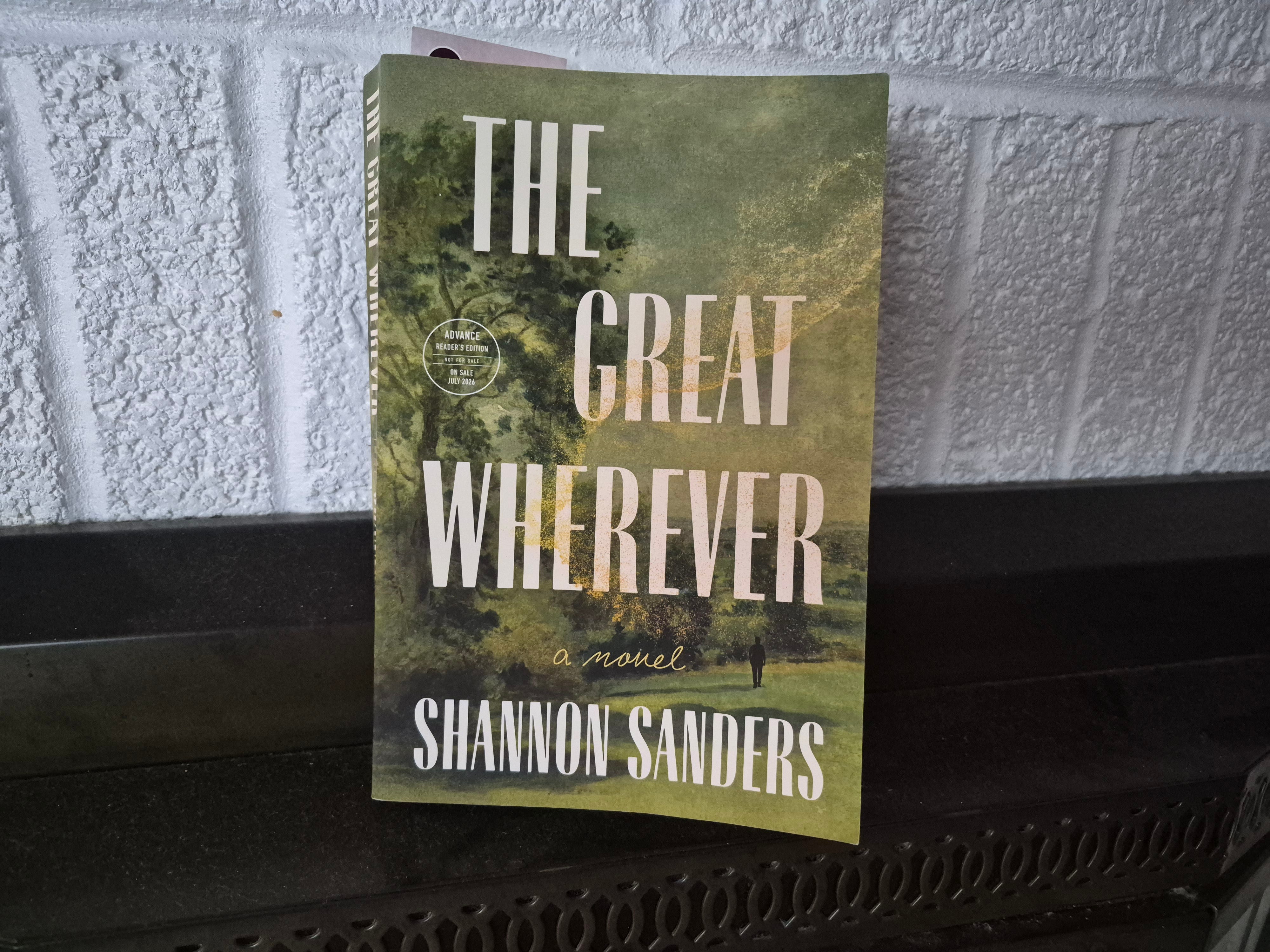
“I do think it would help us all to remember that much as we might want it to be otherwise, life is only for the alive.”
Have you ever read a book that felt like a warm, drowsy summer afternoon, when the world feels suspended in a liminal space and you can’t quite tell time through the haze? A part of you transported back to your own childhood and the enrapture of an immersive story, and another part vaguely aware that you need to get dinner started, but you cannot put the book down?
That is how it feels to read Shannon Sanders’ debut novel, The Great Wherever.
The Great Wherever opens with a ghostly narrator. We don’t yet know who this mysterious storyteller is, only that she died young, and that she is a relative of scatterbrained Aubrey Lamb, our protagonist. Aubrey is, to put it mildly, struggling. She’s working her way through an unforeseen breakup, trying to keep body and soul together as a not-quite-paralegal in expensive Washington, D.C., and figuring out who she is and what she wants to be in the wake of her father’s death. Her big sister Bellamy, respectably married and doing the suburban parenting thing, is not much help. And her mother? Even longer dead than her father. Thanks a lot, Suzette.
Then Aubrey discovers that her father left her a share in a family farm in Tennessee, a property she now co-owns with three older relatives, Hays, Samson, and Darlissa. Maybe this could be the answer to Aubrey’s money troubles! Thinking only of getting away from the scene of her heartbreak (and battling a pesky UTI), Aubrey travels to Tennessee to meet her family and find her roots. And that is where the parallel narrative, telling the story of the Lamb family’s connection to this farm—and to their ancestors—began.
I won’t spoil any further. But I will say that Shannon’s lyrical prose and pragmatic, tongue-in-cheek humor keeps the back-and-forth of the timeline grounded and unconfusing. I frequently had to refer to the family tree in the opening pages—I love a family tree!—but by the end, I felt as if I’d been gathered up into the web of Lamb family lore and the “relentless gossip” of The Great Wherever.
“I mention all that to say that everyone puts their own stamp on things. There is no singular, truest version of any family story; every version comes with misrememberings and projections and savory flourishes. Just like the swapping out of bacon for mushrooms.”1
In sum? 4.5 stars2 and a prized place on my shelf for re-reads.
I was delighted to have the opportunity to interview Shannon via email about the process of writing this book, and even more delighted to share the interview with you today. Questions and answers have been very lightly edited for length and clarity.
You previously wrote about the multigenerational Collins family in COMPANY. Aubrey and Bellamy Lamb figure in several of those stories, most prominently in “Bird of Paradise,” “La Belle Hottentote,” and the titular “Company.” When you were writing COMPANY, did you have plans initially for Aubrey to have her own novel later on?
Not initially! In the linked stories, Aubrey sort of takes a backseat to some of the more developed (and more mature) characters; I always liked her, but wasn’t especially curious about what she’d do next. But to my surprise, when I started drafting the novel (which stemmed from an idea I’d had in the works for years before I got around to writing it), I discovered that at its core was a character very much like Aubrey: impulsive and shortsighted, but charming and just tender enough to win sympathy. That was a huge relief, because I already knew her; writing about her was easy! Like visiting with an old friend.
As an eldest daughter myself (as I know you to be), I felt drawn to Bellamy’s character, even as Aubrey’s richer inner life and focused narrative worked her way into fondness by the end. Was it difficult to write a protagonist who differs so greatly from your own place in the family?
I loved the challenge of it. In my family, we talk about birth order all the time, and we generally find that the stereotypes hold true for us. Disclaimer: I know that eldest daughters aren’t the only people who have burdens, though I’d argue that the burdens tend to be allocated in non-random ways! That said, I am a classic eldest daughter in that I feel and respond strongly to family pressure, strive to be a high achiever at my own expense, and have complex feelings (including intense envy!) toward people who buck expectations (like Bellamy’s feelings toward Aubrey). It all makes internal sense to me, but I’m also aware of how ridiculous it might look to someone with a different compass.
And so, to answer your question: I think that writing outside of our direct experience is one of the most fun things writers get to do. I LOVED writing Bellamy through Aubrey’s eyes! It was, at some points, a real exercise in vanity. It’s not difficult to imagine how a character like Aubrey (who lives paycheck to paycheck and isn’t willing to go to grad school just to please her father, but does at least hold onto the freedoms to date the person she pleases and hit nightly happy hours) would regard an older sister who lives to follow the “rules.”
I loved being able to dive deeper into the Lamb family history through the parallel historical narrative. What did you find most helpful, and most difficult, when researching the segments that took place in the early 20th century?
I’ll be honest: The historical research really stumped me for a while. The first several chapters of the book take place in present day, and those were very easy to write. But when I realized that a lot of the book involved the prior three generations of Aubrey’s family, I did panic a little bit. Actually, quite a lot. I panicked so hard that I stopped writing for a year. The word research put me in mind of dusty university libraries, bibliographies printed in tiny font. Index cards. At one point, I talked myself into believing I would never be able to write the book unless I could somehow swing a robust stay at a residency. It was hard to shake that belief!
Two things helped. First, I talked extensively to my grandmother, who was raised in Tennessee during the era the book spans and whose family history served as a lot of the inspiration for the story. She was so helpful to me. She provided a lot of the small details that (I hope) lend authenticity, such as the dinners the Lambs ate in the 1930s. She is also a huge genealogy buff and over the years has done a lot of work to track down dozens of our Tennessee relatives dating back to pre-Emancipation; that really helped me conceptualize the shortness of a century. Second, I gave myself permission to do my research in pieces. On one day, I read everything I could find about Orange Mound, the outer-Memphis Black neighborhood that was built on what was formerly the famous Deaderick plantation. Another day, I looked into Sears kit houses. I used those research stints to help me sprint toward points where I felt more comfortable writing from instinct, and I didn’t pressure myself to become a subject-matter expert in every single small thing. As any writer will tell you, it is VERY common for 12 hours of obsessive research to wind up boiling down to, like, half a sentence in the final draft. (That happened several times in this book.)
Is your grandmother still living? Has she had the opportunity to read the book?
My grandmother is still living! She’s 92 years old and lives nearby; I’m very lucky that my kids have gotten to know her. She was one of the first people I told about the book, and she has an advance copy (though she hasn’t read it yet). When the audiobook becomes available, I plan to share it with her!
Have you visited family gravesites or other locations in Tennessee? Were these helpful at all in drawing a connection with the land you wrote about?
I’m glad you asked, because this is a major part of the book’s origin story! While The Great Wherever is fiction, it definitely has its roots in certain elements of my own family history, which I learned in small pieces throughout my childhood and afterward. During our reunion trips to Tennessee, I’ve gotten to spend time in a number of locations that definitely inspired parts of the book. First and foremost, the farmland my grandmother co-owns with her living sister and some of the children of her late siblings—like the parcel in the book, it’s large and wooded and very much a traditional piece of farmland (though it isn’t currently a working farm). I’ve gotten to visit it a few times and found it both charming and overwhelming. My grandmother and her sister also co-own a single-family house in a very homey small town nearby; it’s filled with photographs of their parents as well as of their children, grandchildren, great-grandchildren, and so on. There is also a nearby church (somewhat like the one in the book), and I remember being told as a child that some of our distant relatives were buried in the cemetery behind it.
You have written previously about the tough but fulfilling entanglement of creative work and parenting along with livelihood work. So I have to ask the question every mom who writes must be thinking: when did this book get written? Did you find yourself jotting down sentences in small fragments of interrupted time, or were you able to carve out any marathon sessions?
I love answering this question, because I greatly want other writer-moms to know that it is possible. The short answer is that I wrote the vast majority of this book in the hours between 9:30 pm and midnight, after my kids were asleep and before I too was asleep. The long answer is that what I was able to do depended entirely on a hundred factors including what was happening in my life and what was happening in the book. As I mentioned above, I took a yearlong break when the research overwhelmed me. (I also had twin infants during this time, but I can’t blame them because in my heart I know the research was the bigger obstacle.) As soon as that break ended, I set a goal of writing for one or two hours a night, and I did it. To make it happen, I drank a lot of wine, listened to the same handful of songs on repeat, and forewent things like TV. (And as soon as the draft was done, I VERY quickly binged Succession, Severance, and a bunch of other shows.) It was one long marathon broken up into regular chunks. I wish I were the kind of writer who could collect lines on napkins or in voice notes, but to my chagrin I only work longform!
Note from Amy: I am writing this article on my laptop in bits and pieces while my children blast Jake and the Neverland Pirates in the background. #momswhowrite
There are so many complex characters in TGW, and one I would have loved to get to know a little better was Samson. I saw a lot of echoes of his father Elijah in him, and I’m curious if you would say Micah has many similarities to Joah.
I love that you say that about Samson! Another great pleasure of writing this book was including some ancillary characters who didn’t get as much air time but hopefully still cohered within the world of the story. I agree that Samson is a logical son for Elijah; and I think Micah is the same for Joah, though in a different way. They aren’t similar, but I think it holds that a person like Joah would raise a person like Micah, who would in turn raise a person like Aubrey. One thing Joah, Micah, and Aubrey all have in common is some degree of belief that they will find salvation in white society. You didn’t ask, but Aubrey also shares with her grandfather quite a lot of angst at being (or feeling like) the younger, lesser sibling. I really enjoyed setting up those details!
Would you ever consider writing more about these characters? If so, who?
Even though she’s shown up in two books at this point, I still don’t feel like I’ve given Bellamy her due! She’s the character I most relate to, and I’d like to give her more dimension someday.
I’ll also share that I’ve been starting to plot what I think will be my next book, and—believe it or not—it looks like Boyd might make an appearance...
I’m excited to see where Boyd ends up, though not with the same fondness I feel for Samson and Bellamy! Are there any similar novels about multigenerational drama and an intense connection to ancestry that you would recommend, for readers who enjoyed TGW and would love to read something similar? (If not I will skip this question)
Absolutely!! Most recently, Nikesha Elise Williams’s The Seven Daughters of Dupree, which follows seven generations of very different types of women, fits this description perfectly. It came out earlier this year. Yaa Gyasi’s Homegoing is, I would say, a modern classic in this genre. The same is true of Honorée Fannone Jeffers’s The Love Songs of W.E.B. Du Bois. This is lofty, but I would also love to imagine this book is in conversation with Ann Patchett’s Commonwealth, which is a beautiful novel that spans the branches of a family tree (though more laterally than vertically).
You can say anything you want here in The Great Wherever.
I, too, loved Ann Patchett’s sprawling yet intimate Commonwealth, and I think Shannon’s comparison is apt! I hope you will enjoy Shannon’s novel as much as I did, and to this end I am giving away one hardcover copy of Shannon Sanders’ THE GREAT WHEREVER to one of my much-appreciated subscribers! This giveaway is open to paid/comped subscribers only, and in the U.S. only (because shipping is a bear, I’m so sorry). Please leave a comment for a chance to win this beautiful book (and restack this post for an additional entry)! I will announce a winner on Tuesday, July 14t.
*EDIT July 14th, 2026: congratulations to Andrew Knott! I’ll message you about shipping the book.
Enjoyed this post and want to say so with a small testimonial? You can tip the author here.
You might also enjoy…
Wild for Austen and Devoney Looser: Book Review and Writer Showcase

I first became aware of Professor Devoney Looser when she appeared on Karen Swallow Prior’s podcast Jane and Jesus in 2022. Since then I’ve enjoyed reading her online work, and when she announced a new book slated for release in September 2025, I jumped on the chance to read an advance copy and write a review.
Sanders, 66.
Content warning to the sensitive reader for some traumatic deaths, abortions, and maybe a few extraneous details about the nitty gritty of a urinary tract infection.
This sounds like a great read! Awesome interview, as well.
Great interview. Adding this to my tbr. Would love to win a copy!