
What Jane Austen and Terry Pratchett Have in Common
Satire with courage, brain, and heart. (Lions, tigers, and bears not included.)


“His progress through life was hampered by his tremendous sense of his own ignorance, a disability which affects all too few.”
—Maskerade
“She was heartily ashamed of her ignorance. A misplaced shame. Where people wish to attach, they should always be ignorant. To come with a well–informed mind is to come with an inability of administering to the vanity of others, which a sensible person would always wish to avoid. A woman especially, if she have the misfortune of knowing anything, should conceal it as well as she can.”
—Northanger Abbey
I’ve been reading Jane Austen since I was fourteen years old and first discovered Pride and Prejudice. She’s my favorite author, hands down. Throughout twenty-five years of reading, I’ve gravitated toward the British classics: old-fashioned stories of humanity, love, relationships, families, “common life,” with just a smattering of political intrigue. Austen is, of course, the North Star of this for me, but I’ve also enjoyed Dickens, Bronte (Charlotte and Anne, that is; Emily can shove it), Forster, Gaskell, etc. Someday I’ll probably crack open an Anthony Trollope but that day is not this day.
Fantasy was always outside my realm—pun very much intended and in fact sort of muscled in there. Hope you liked it. I still haven’t read Lord of the Rings, and though I enjoyed Narnia, and the silliness of the American The Princess Bride plus a few juvenile novels of imagination and magic, I never thought I’d get into the more fantastical worldbuilding. The very concept of worldbuilding bored me! I don’t want to slog through pages and pages of who went to war with whom and how this magic system works and why everyone is named something that sounds like a desperate and ultimately unsuccessful Scrabble play.
But then my friend Stephanie all but begged me to give Terry Pratchett a try.
She was persuasive, and a scrap of text in a Tumblr post intrigued me.
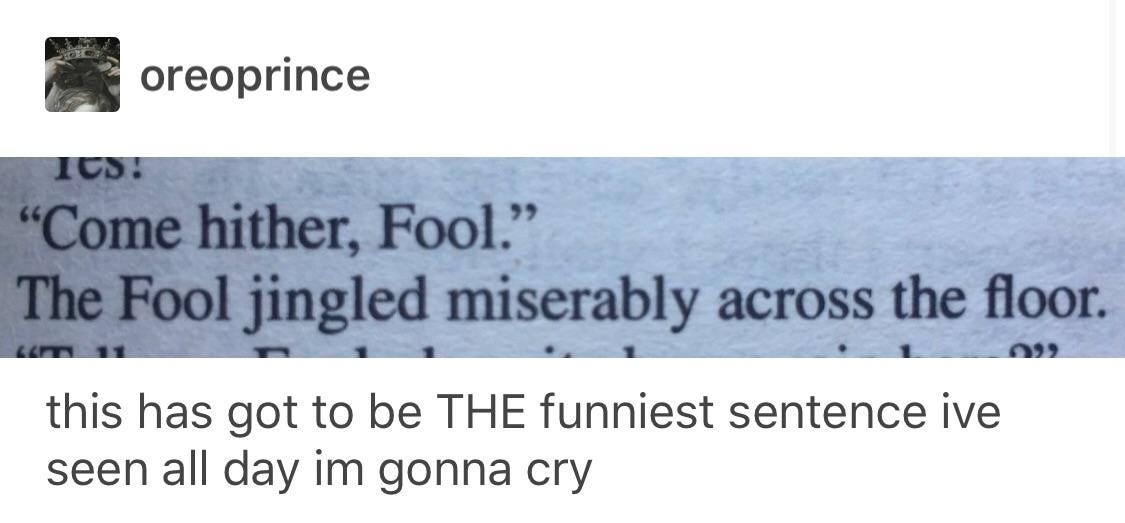
So it was that I got Wyrd Sisters (from whence this excerpt is plucked) from the library, and fell heels over head into the universe of the Discworld. I have only occasionally come up for air since.
This post isn’t meant to convince you to read Terry Pratchett, or to explain the Discworld conceit, or to rank my favorite novels in a highly subjective and ever-changing list. Today I just want to explain why I have become such a devoted Pratchett fan, and what it is in his books that has brought him to my Top Five of favorite authors (never disturbing Herself in the top-ranking place, of course).
Terry Pratchett is a satirist and humorist, and many have described Jane Austen with just these terms. (She herself only called herself a novelist and an author, to the best of my knowledge— but she did say she could not “write a serious romance under any motive than to save my life.”1) Both wrote comedic fiction that subtly, or not-so-subtly, pointed out the flaws and foibles, the whims and inconsistencies, of the people among whom, and the societies in which, they lived. Austen wrote of real life in England, of course, and Pratchett wrote of a flat earth carried on the backs of four giant turtles, but it’s mostly the same in the end.
“The advantages of natural folly in a beautiful girl have been already set forth by the capital pen of a sister author; and to her treatment of the subject I will only add, in justice to men, that though to the larger and more trifling part of the sex, imbecility in females is a great enhancement of their personal charms, there is a portion of them too reasonable and too well informed themselves to desire anything more in woman than ignorance.”
—Northanger Abbey
No one who had seen Catherine Morland in her infancy would have supposed her to be a heroine. Austen takes pains, right at the outset of Northanger Abbey, to tell us that Catherine does not fit the mold for Gothic fiction. Yet the entirety of Catherine’s story is informed by, makes allusions to, and ultimately upends the principles of Gothic fiction. A quick summary for those who want it (the others may save fourteen seconds by skipping to the next paragraph): Catherine is a respectable but somewhat poor rector’s daughter who reads “horrid novels” avidly. When she accompanies wealthy friends to the worldly city of Bath, she falls in love with a young man about whose family she begins to imagine all kinds of intrigue and hidden secrets (influenced, of course, by her melodramatic reading fare) which threaten her budding romance and her safety as a young woman in a society that values wealth and position over character and compassion. The novel ends happily, however, which is perhaps the greatest aspect of the ridiculous in the “real world”—and the most satisfying to the reader.
Much has been written on the themes of Northanger Abbey and how it smoothly and effectively parodies Gothic fiction. I cannot sit down to write a serious critique of it even to save my life, but I can point out where Northanger Abbey succeeds when so many other parodies and satires simply cannot compare. As Austen tells us of Catherine’s wild imagination and silly conclusion-jumping, she does so with tenderness and patience. It would be so easy to make Catherine the butt of every joke, to tell a story that mocks frivolous young women instead of pointing out the darkness and greed of the world which treats such young women so unkindly. To write meanly of Catherine would be to punch down, and as I argued last summer, Austen refuses to do that.
“Ahahahahaha! Ahahahaha! Aahahaha!
BEWARE!!!!!
Yrs Sincerely,
The Opera Ghost”
…
“What sort of person,” said Salzella patiently, “sits down and writes a maniacal laugh? And all those exclamation marks, you notice? Five? A sure sign of someone who wears his underpants on his head. Opera can do that to a man.”
—Maskerade
Pratchett’s form of humor is a bit more on-the-nose, or at least it appears so to the modern reader. In Maskerade, the novel I’m focusing on in this essay (though it should be viewed as generally representative of his oeuvre), he sends up Andrew Lloyd Webber’s The Phantom of the Opera. The main character, Agnes Nitt, is a country girl who gets a job in the big city of Ankh-Morpork as a chorus member at the opera house. The opera house, unfortunately, is plagued by a murderous and mysterious Ghost, and the new owner is making things difficult. Oh, Agnes also happens to be a witch, or very nearly one. And her would-be mentors, Nanny Ogg and Granny Weatherwax, have followed her to Ankh-Morpork to recruit her into their coven (and to collect royalties on a cookbook written by Nanny Ogg).
Fun little side note: the themes of Nanny Ogg’s cookbook, the rights of which were purchased from her by an unscrupulous publisher for his own financial gain and no real benefit to the worthy Authoress, remind me quite strongly of what happened to Jane Austen when she first sold her Northanger Abbey manuscript (then titled Susan) to a dingbat publisher in 1803. The aforementioned dingbat, Crosby & Co., did nothing with the manuscript and after a decade Austen bought it back from them for 10 pounds. It was published posthumously. Okay, so it’s not that similar to Nanny Ogg’s cookbook but the train of my thought ran off on a siding and biffed the buffers, I guess. Let’s return to the thread.
There is so much to love about Maskerade—the witty narrative, farcical to the point of absurdity— the fun dialogue, even between the stupidest characters— the tender compassion and best-of-humanity that runs through even encounters with DEATH himself (and the DEATH OF RATS!)—and the sly jibes about other installments in the musical theatre world—but the warmth with which Pratchett writes about Agnes Nitt is perhaps my favorite part.
Like Austen with Catherine, Pratchett uses Agnes as a mirror (a magic mirror? with a masked figure in it??) to the foibles and follies around her, making plenty of her own silly mistakes but never serving as the butt of the joke. Agnes is naive in many of the same ways that Catherine is, but she is at her core a sensible and kind person, and her Virtue is Rewarded. Not in a smarmy moralistic way, either, but in a way that makes you root for her. You know things aren’t going to end well when she accepts voice lessons from the Opera Ghost, just as you know Catherine is being ridiculous when she fears a laundry list at the back of a wardrobe is a catalog of General Tilney’s secret crimes.
We have all done stupid things, and thought stupid things, and been a little stupid now and then. Whether Agnes and Catherine are “relatable” to you is not the point; the point is that in making them sympathetic, real people, Austen and Pratchett are elevating satire from a literary device to a genuine story.
P.G. Wodehouse, another of my favorite British humorists, will be playing the part today of the scapegoat in this little argument. Listen, I love Jeeves and Wooster as much as the next sarcastic former homeschooler. But reading Wodehouse is like drinking a cupcake-topped Reese’s Pieces milkshake: it’s delicious and fun and you tell your friends about it and fondly remember how good it was but you can’t possibly do it every day, and it doesn’t nourish you beyond the very basics of, like, calories. (Too many of them.)
Wodehouse is hilarious in small doses, but after a while his books begin to run together. I am sure there are those who would say the same about Pratchett or even Austen, but there are wrong opinions in every Internet forum and such talk should not bother the serious reader. Bertie Wooster is fun, ridiculous, even endearing, but you are absolutely laughing at him the whole time he’s losing his mind over a cow-shaped creamer. And Jeeves, the enigmatic Great Brain we perhaps wish we could be, is not exactly plumbing the depths of character development as he intones, “There is no time, sir, at which ties do not matter.”
Similarly, Oscar Wilde skewered the British upper class in The Importance of Being Earnest (another delightful read!) and did so with a biting wit that is still being taught in English literature classes today, but the jokes and sarcasm of Algernons and Gwendolens and Lady Bracknells are revealing the nonsense and inconsistencies of cultural norms, not who we are as individual, flawed people who believe silly things and do sillier things because deep down we all want to be loved. We want to be seen and accepted, whether as a chorus girl who is too fat to be a leading lady and too smart and kind to get “ahead” in showbiz, or a sheltered rector’s daughter whose knowledge of the world has been shaped by shoddy fiction but whose character is stronger than the finer and more learned people who try to change her.
To get to the bottom of human nature, you need a book with a heart— a book that echoes our deepest vulnerabilities, and reassures us that a) we are not alone and b) it’s okay to laugh at ourselves.
Oh, and that women are inevitably going to be judged on their appearance in every culture and society and enlightened group of thinkers, the world over. It can’t be helped, but at least we can laugh at that, too.
“No one had asked her, before she was born, whether she wanted a lovely personality or whether she'd prefer, say, a miserable personality but a body that could take size 9 in dresses. Instead, people would take pains to tell her that beauty was only skin-deep, as if a man ever fell for an attractive pair of kidneys.”
—Maskerade
Letter to Rev. James Clark on April 1, 1816. https://janeaustensworld.com/2011/04/01/letter-written-by-jane-austen-april-1-1816/
This is great, Amy. I haven't read Terry Pratchett, but you are so right about how Austen depicts Catherine Morland. I will have to reread Northanger Abbey soon; it's such a delightful book.
I too am a sarcastic former homeschooler and I too love Jeeves and Wooster. 😁 But you’re right that it’s dessert and not a main course. Have you seen the British TV series starring Stephen Fry and Hugh Laurie? It went off the rails a bit at the end but most of it is so good and hilarious. It’s hard for me not to visualize the two of them when I’m reading Wodehouse.