
Mr. Darcy is Not a Dreamboat
I don't care what pop culture told you. Read the BOOK.

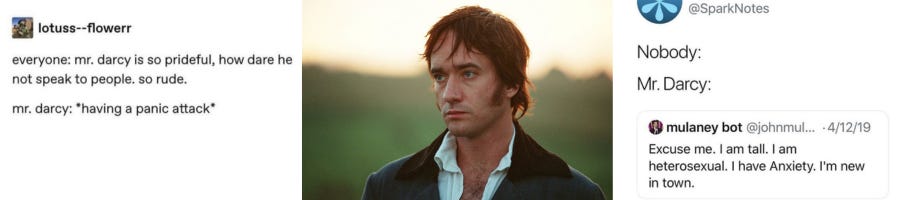
I don’t know who the most-recognized romantic hero of English literature is. I haven’t conducted surveys or double-blind studies on widespread perception of landed, brooding gentry. So take this with a grain of salt if you like, but I think it’s pretty safe to say Fitzwilliam Darcy of Pride and Prejudice is one of the most well-known romantic heroes in English literature. If you’re reading this, you’ve probably at least heard of him, even if you’ve never read the book or watched any of the film adaptations. And if you’re reading this but you’ve never heard of Mr. Darcy, color me intrigued as to how you found my Substack in the first place.
For my own part, a reader of the classics who is Very Online in spaces that accommodate many other readers of the classics, Darcy references are everywhere. “A single man in possession of a good fortune who must be in want of a wife”— never mind that the text is speaking of Mr. Bingley, this famous phrase is irrevocably linked to Mr. Darcy, master of Pemberley estate, elegant dancer, chivalrous rescuer of straying young ladies, mascot of antisocial hermits, smoldering and brooding paramour of passion.
The last two, at least, are pure hype. I can’t even say Hollywood, because though I think Hollywood is partly to blame—we’ll get to that—I think the memeification of literature bears the brunt of this problem.
When I was a teenager, my sister and some friends and I were discussing North and South by Elizabeth Gaskell one evening. Our respective parents (also friends in their own right) were tangentially dabbling in the conversation as dinner ended. John Thornton, the smoldering hero played by a young Richard Armitage in the 2004 miniseries, was the subject—was he a hero from the beginning of the story, or an anti-hero who changes as the story progresses? I actually can't remember where I landed in the friendly argument. But I do remember my friends’ dad leaning in and asking, “Okay, but the real question is: does he change for the better, or do we just come to understand him better?”
It's a great question for John Thornton, a mill owner in the north of England who is balancing the complexities of labor rights (and mill workers’ strikes) with the necessities of keeping his business in operation. But it’s not so applicable for Mr. Darcy, even though it seems that a lot of popular perception of him has sailed right past the posing of those two options to land squarely on the latter.
Take the 2005 film, for instance. I have a lot of beef with this specific adaptation of Pride and Prejudice and how it portrays Austen's classic story, which should probably be the subject of another post and in fact has been simmering in my drafts for a while.
(In the meantime, I did write something more general about all P&P adaptations which you might enjoy.)
Here's Why Pride and Prejudice Will Never Translate Perfectly to the Screen

The Janeite world is buzzing right now with the news that Netflix is slated to adapt Pride and Prejudice for the small (laptop) screen. Or the large screen, if you have a smart TV. Or the even smaller screen if you’re watching on your phone in bed at night when the kids are asleep.
But back to Mr. Darcy. In Joe Wright’s 2005 film, hereafter referred to as P&P05, Darcy is played by Matthew Macfadyen, a handsome and talented actor who freely admitted to never having read the book the screenplay was based on. Indeed, he argued (in that interview I just linked) that Darcy’s apparent coldness and arrogance is actually due to feeling insecure in the world and missing his dead parents.
Sigh.
When the film came out, featuring such additions as The Hand Flex Scene (“he’s repressed! It’s romantic!”) and The Striding Across the Meadows In His Unmentionables Scene (“it’s swoonworthy! My kingdom for a man who can walk on wet grass without accumulating six inches of pajama-pant mud”), Darcy’s place in the Romance Canon became firmly fixed as Misunderstood Shy Guy Who Is Also Hot.
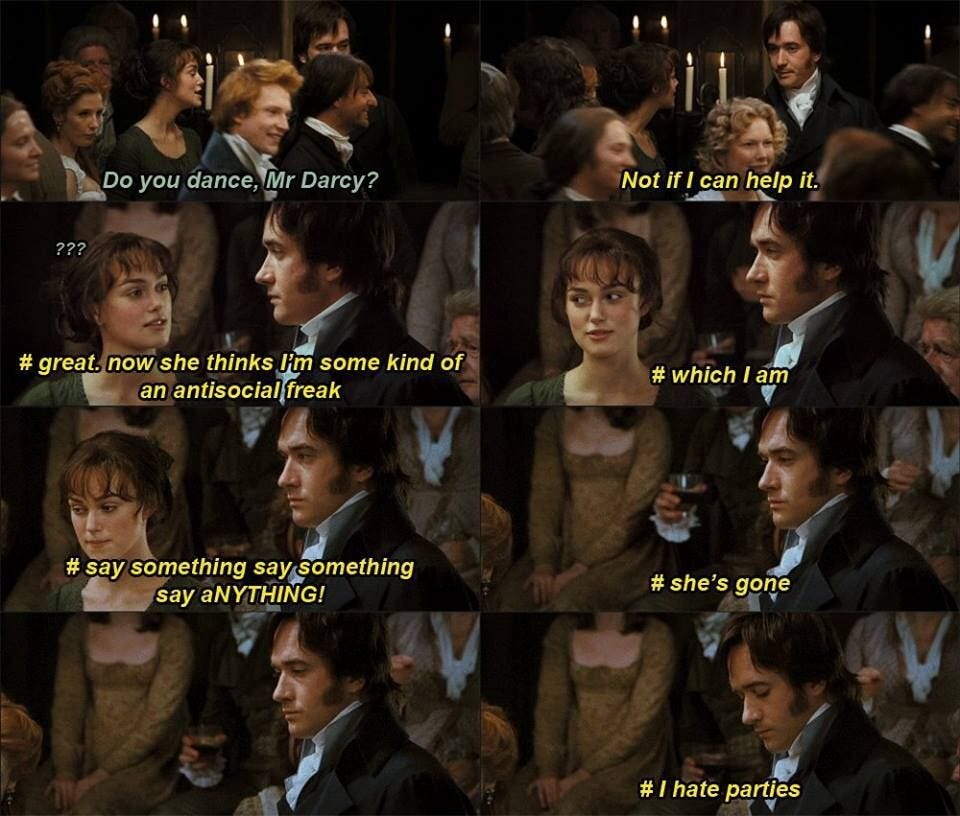
Sigh again.
Anyway, so this is not how Mr. Darcy actually is in the book. Neither is the line “I love you, most ardently.” PLEASE.
This may come as a shock to some (not you, the brilliant person reading this, of course), but the title that Jane Austen chose for her novel actually reflects some of the main themes of the story. Clever, eh? It is called PRIDE and PREJUDICE because to a certain degree each of the main characters display those attributes at the beginning of the story and undergo a change before the end. It is not called Shy Hand Flexing and Prejudice, nor is it called Socially Awkward Agoraphobic Lobster and Prejudice. Darcy and Lizzy are both flawed people who are forced, by those they love (or think they love) to confront the worst tendencies of their own character, and they each become the better for it. Jane Austen did not write serious romance; she wrote virtue-informed literature that critiqued her own social microcosm. She was not setting out to create the ultimate Book Boyfriend, and indeed I think she would be equal parts appalled and excessively diverted to see what the public perception of Darcy has turned out to be.
The first forensic exploration we get into the character flaws of both Darcy and Elizabeth is in chapter 11, when Jane is ill at Netherfield, Elizabeth has come to visit her (petticoat six inches deep in mud!) and as they begin to converse with Miss Bingley (flirtatiously on Caroline’s part, amusedly on Elizabeth’s, and inscrutably on Darcy’s) they begin to talk of virtue and whether it can be laughed at, prompting Elizabeth to say,
“I hope I never ridicule what is wise or good. Follies and nonsense, whims and inconsistencies, do divert me, I own, and I laugh at them whenever I can. But these, I suppose, are precisely what you are without.”
[Darcy replies:] “Perhaps that is not possible for any one. But it has been the study of my life to avoid those weaknesses which often expose a strong understanding to ridicule.”
“Such as vanity and pride.”
“Yes, vanity is a weakness indeed. But pride—where there is a real superiority of mind, pride will be always under good regulation.”1
Darcy is not too reserved to speak to Elizabeth about this somewhat emotionally intimate subject, nor too awkward to make a joke, a few minutes before, about Miss Bingley’s thinly veiled excuse for showing off her figure. He is not mesmerized by Elizabeth’s fine eyes and fumbling for words, intimidated by the Bingley and Bennets’ charm: he is looking down his nose at the people assembled in his best friend’s drawing room, and finding their ideas wanting.
Later in the same chapter, as the discussion continues—Elizabeth says, sarcastically, that Mr. Darcy is without defect. He demurs,
“I have faults enough, but they are not, I hope, of understanding. My temper I dare not vouch for. It is, I believe, too little yielding—certainly too little for the convenience of the world. I cannot forget the follies and vices of others so soon as I ought, nor their offences against myself. My feelings are not puffed about with every attempt to move them. My temper would perhaps be called resentful. My good opinion once lost is lost for ever.”
“That is a failing indeed!” cried Elizabeth. “Implacable resentment is a shade in a character. But you have chosen your fault well. I really cannot laugh at it. You are safe from me.”
“There is, I believe, in every disposition a tendency to some particular evil—a natural defect, which not even the best education can overcome.”
“And your defect is a propensity to hate everybody.”
“And yours,” he replied, with a smile, “is wilfully to misunderstand them.”2
Again, Darcy isn’t writhing in humiliation over his own doltishness here. He’s smug, happy in his perception of himself and calmly indifferent to anyone who might critique his self-righteous view of his own personality traits. “Where are the real-life men like Mr. Darcy?” Janeites sometimes lament. They’re here! Among us! They’re in boardrooms and tech startups and church sanctuaries and all over the gosh-darned internet. We’ve all met someone like First Volume Darcy: conceited, fully aware of how people perceive him, and yet completely unwilling to admit that the idiosyncrasies he admits to are actually full-on vices.
Of course, we know Darcy doesn’t stay this way. And it’s not because we simply get to know him better (although we do). Even at the end of the novel, when love has been declared and proposals accepted, we see the difference between what Elizabeth perceives versus reality. Upon learning of the latest engagement, Mr. Bennet exclaims in dismay that Elizabeth should be interested in such a “proud, unpleasant man,” and when Elizabeth insists that he has “no improper pride,” that everyone has been mistaken in their opinion of him, she gives “repeated assurances that Mr. Darcy was really the object of her choice, by explaining the gradual change which her estimation of him had undergone, relating her absolute certainty that his affection was not the work of a day, but had stood the test of many months suspense, and enumerating with energy all his good qualities, she did conquer her father's incredulity, and reconcile him to the match.”3
Elizabeth is in love, and eager to see in her beloved all the virtues she can conceive of, taking the blame for their former misunderstandings. We know, of course, that Darcy has openly admitted to having been given good principles as a child, but “left to follow them in pride and conceit.” Elizabeth is choosing not to see this, and can we blame her? She is prejudiced, after all, this time in favor of the man she once loathed. At most, she allows herself to concede that he can’t really take a joke.
Elizabeth longed to observe that Mr. Bingley had been a most delightful friend—so easily guided, that his worth was invaluable; but she checked herself. She remembered that he had yet to learn to be laught at, and it was rather too early to begin.4
A key component of the quintessential Austen hero is a man who can make sport for his neighbors and laugh at them in his turn (though Mr. Bennet, from whom this quote originated, is a far cry from a hero)—and laugh at himself, too. (We see this perhaps most strongly in Henry Tilney and Mr. Knightley but those are topics for another day.) Lack of a sense of humor, particularly when it extends to oneself, is a weakness indeed, at least where Austen is concerned.
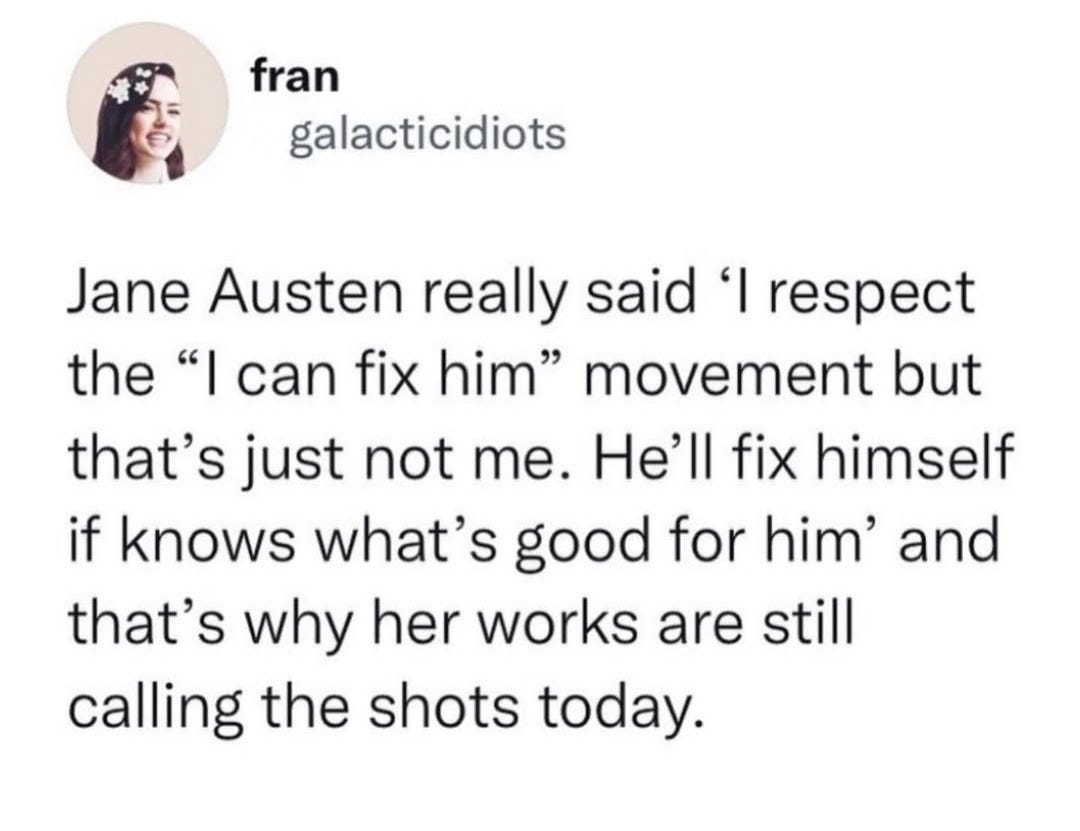
Mr. Darcy isn’t meant to be a shining paragon of virtue, or a picture of perfection that would make Austen herself feel “sick and wicked.”5 He’s a whole problem, and that’s the point. As Susan Moore points out for Vanity Fair (so many thinkpieces about Darcy these days!) he doesn’t get fixed. He does the fixing. That’s also the point.
Though I do not agree with all the conclusions Sebastian Faulks draws in this essay for BBC Culture (actually an excerpt from a larger introduction to Austen’s works), I think he hits the nail on the head when he says that the “idea of Darcy as a romantic gallant is a delusion of the reader, not an intention of the writer.” The reader (or movie-viewer) wants to see Darcy as something to aspire to, but Austen was laughing in her sleeve at him and his superiority complex for almost the entire novel. Even when his behavior turns around, even after he saves Lydia and reconciles Jane and Bingley, she gives him a little comeuppance with the people he formerly abhorred (and still does in some cases).
Lady Catherine had been rendered so exceedingly angry by the contents of her nephew’s letter, that Charlotte, really rejoicing in the match, was anxious to get away till the storm was blown over. At such a moment the arrival of her friend was a sincere pleasure to Elizabeth, though in the course of their meetings she must sometimes think the pleasure dearly bought, when she saw Mr. Darcy exposed to all the parading and obsequious civility of her husband. He bore it, however, with admirable calmness. He could even listen to Sir William Lucas, when he complimented him on carrying away the brightest jewel of the country, and expressed his hopes of their all meeting frequently at St. James’s, with very decent composure. If he did shrug his shoulders, it was not till Sir William was out of sight.6
Why does any of this matter? Well, first of all, you’re reading an article by an avid Janeite writing to other avid Janeites on a website devoted to nitpicking literature, so jot that down. But in the grand scheme of things, who cares if a group of starry-eyed bookworms declare Mr. Darcy to be the ultimate #ClassicsCrush?
It matters because the way we read books matters, and the way we absorb the themes and implications of literature matter. It matters because none of us spring from child to adult fully formed, with our character set in stone. Miss Stacy might disagree, but Aunt Jamesina would back me up, I think.7 If Fitzwilliam Darcy is the unattainable Perfect Man, no real-life boyfriend is ever going to measure up. I certainly don’t think it would hurt Men At Large to take a leaf or two out of an Austen novel8 when trying to form their own characters, but the stubborn fact is that people are full of flaws. Those flaws are part of what it means to be human, yes, but they are also not insurmountable. The attraction of Mr. Darcy is not to be found in his massive drafty house or his tallness or his slow-but-elegant handwriting—it’s the fact that he has the ability to self-reflect and to change course. None of this happens overnight; as with his love for Elizabeth, which was “in the middle before he knew it had begun,” his ability to admit when he was wrong is a steadily-blossoming plant that sprouts when Elizabeth refuses his first proposal and is in full flower when they speak again on the road outside Lucas Lodge.
If we look at Darcy as a flawless cinnamon roll of a man, we miss his character arc. And if we sigh over his snippy comments and see them as dark and dashing, we deny that the character arc is necessary. Darcy isn’t an anti-hero: to view him as such is to, again, miss the point. He is a human being with equal streaks of integrity and selfishness, and a man who knows how to dress for dinner, not a punk rock bad boy.
Once again I am reminded of the Benoit Blanc meme. Except I’d need to edit it a little bit.
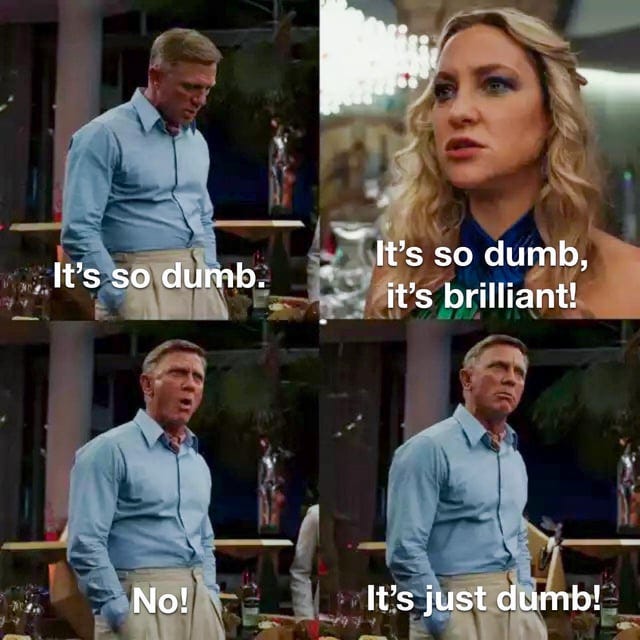
“He’s a jerk!”
“He’s such a jerk that he makes it ROMANTIC.”
“NO! HE’S JUST A JERK!”
(Until he changes, that is.)
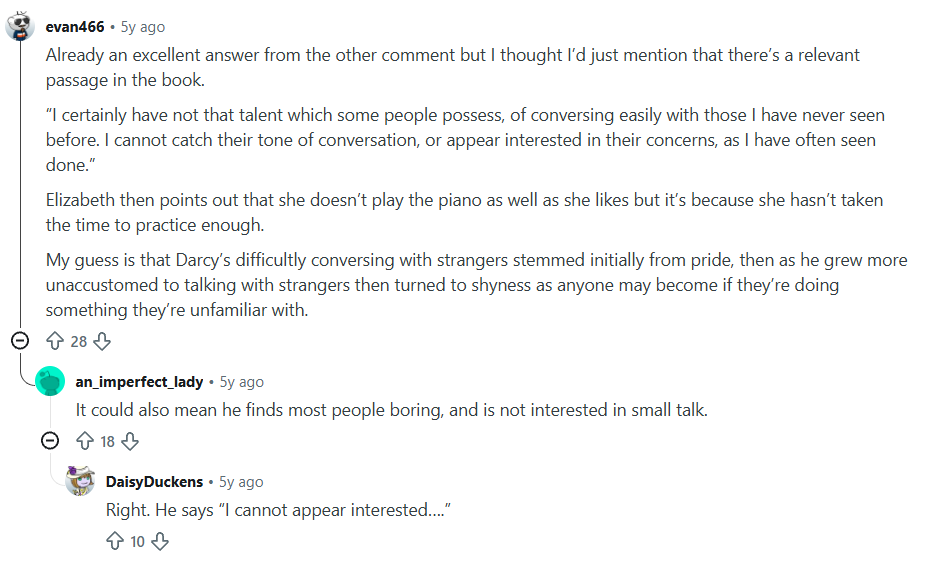
As I roamed around the internet finding backup and inspiration for this piece, this Reddit thread was an interesting look at the question of anxiety versus arrogance, and this particular exchange amused me immensely. You tell ’em, Imperfect Lady.
By the way, though I don’t think his portrayal is perfect by any means, I feel Colin Firth approached the role of Darcy with the gravitas and self-righteousness that it deserved. Is he perhaps responsible for a bit too much of the Byronic association with the character? Yes. The smoldering was a bit much, as was the Definitely Not In the Book Lake Scene. Could he have unbent a bit more, especially at the end? Sure. But that just leaves room for a new, and perhaps even better, interpretation.
Will Netflix bring it? We can only hope, but their previous attempt at Persuasion is not promising. In such cases as these, however, a good memory is unpardonable.9
Enjoyed this post and want to say so with a small testimonial? You can tip the author here.
Austen, Jane. Pride and Prejudice, chapter 11.
Austen, chapter 11.
Austen, chapter 59.
Austen, chapter 58.
Letter from Jane Austen to her niece Anna, 23-25 March 1817.
Austen, chapter 60.
Montgomery, L.M. Anne of the Island, chapter 19, “An Interlude.” Anne is musing about her twentieth birthday and says that her beloved teacher Miss Stacy told her that her character would be formed by age twenty, for good or evil, and Aunt Jamesina scoffs and says that characters are cracked in a hundred places, and her philosophy is to do her duty by God and her neighbor, and have a good time.
and I do NOT mean John Willoughby
yes of course this is also from P&P; chapter 59 to be exact.
This is really good. I think there's a distinct lack of understanding of character growth, complexity, and nuance in the cultural discourse these days. And I think we're the poorer for it.